The Independent Couriers & Dispatchers Fix Kit
Built for Amazon Flex drivers, medical and independent couriers, and freight dispatchers.
Whether you drive for Amazon Flex or run your own freight dispatch business, the number that matters most usually isn't the advertised rate — it's what's actually left, or actually at risk, once the real costs and rules underneath it are counted. This kit finds where the money leaks in your own work and gives you the steps and the words to close each one.
Opens secure checkout. Instant download after payment. 30 days to ask for a refund — refund policy · terms
The 7 leaks it covers
3 you can close it · 2 the other side owes it · 2 a pro decides
- Dispatcher fee set by habit, not by hours each truck actually takesWhere to look first: For each carrier client, write down what you collected last month and the hours you spent on that truck (load searching, calls, paperwork, problems).Keep it from coming back: Before you take on a new truck, write the fee, what it's charged on, and when it's due into the signed agreement, and track your hours per truck from day one.You can close it
- 2026 miles logged at one rate when the IRS changed it on July 1Where to look first: Split your 2026 mileage log at July 1: one total for Jan 1-Jun 30, one for Jul 1-Dec 31.Keep it from coming back: Log every business trip the day you drive it, from your own odometer, so the miles hold up whatever the rate turns out to be.You can close it
- Flex block pay looks like an hourly wage until fuel, wear and real hours come outWhere to look first: For the next 2-4 weeks, log every block: real start and finish time, odometer at home before you leave and when you get back home, and the pay shown.Keep it from coming back: Screenshot every offer when you accept it, and check each block against your own floor before you tap accept - not after the week is done.You can close it
- Classification question: 1099 label vs the state's ABC test (NJ suit is an allegation)Where to look first: Know this first: New Jersey's case against Amazon is a lawsuit - claims, not a ruling. Nothing has been decided.Keep it from coming back: Keep the records as you go - screenshots of each block, any instructions, real start and end times. A classification question can only be answered from records, and records made later are weaker.The other side owes it
- One platform, one algorithm: deactivation can end the income with little appealWhere to look first: Once a week, screenshot your standing and performance metrics in the app. Save them somewhere that isn't your phone.Keep it from coming back: Weekly metric screenshots, proof saved for every problem stop, and a second income source lined up before you need it.The other side owes it
- Setting aside tax from gross platform pay when the tax is figured on netWhere to look first: Start a mileage log today if you don't have one: date, where you started and ended, what the trip was for, and miles. Platform-reported miles usually only cover the delivery leg - log yours from your own odometer.Keep it from coming back: Log miles the same day you drive them, and move your preparer's set-aside amount out of every payout before you spend any of it.A pro decides
- Dispatch work drifting across the FMCSA broker line without broker authorityWhere to look first: Pull your last 30 days of loads and your signed agreement with each carrier you dispatch for.Keep it from coming back: Before you accept any load, check two things: who is paying whom, and whose truck it's for. If the money or the shipper relationship runs through you, stop and don't book it until you have broker authority.A pro decides
Free: one full leak from this kit
No sign-up, no email. Here is leak 1 of 7 exactly as it appears in the kit, so you can see what you get before you buy.
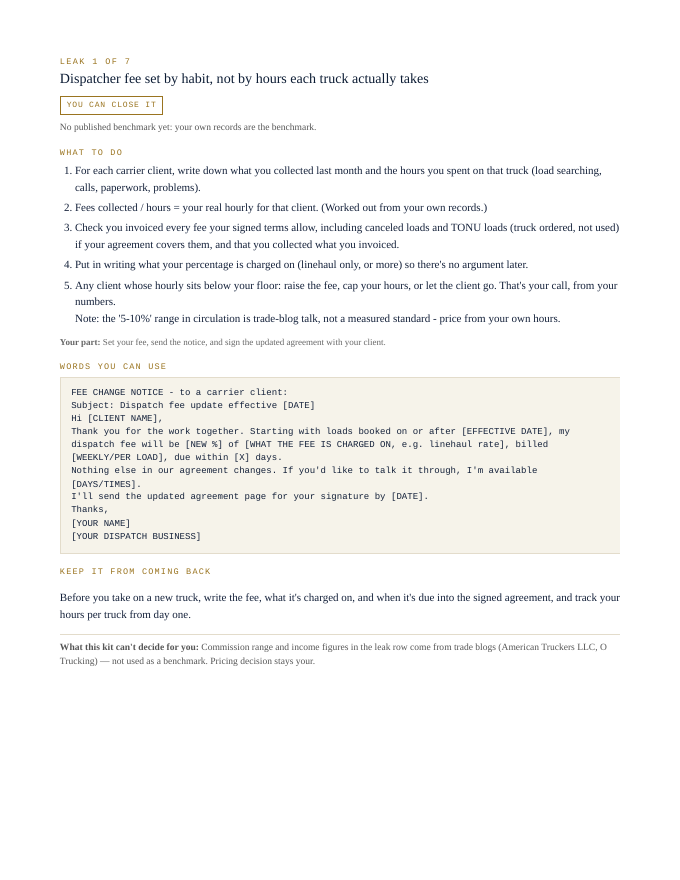
Dispatcher fee set by habit, not by hours each truck actually takes
You can close it- For each carrier client, write down what you collected last month and the hours you spent on that truck (load searching, calls, paperwork, problems).
- Fees collected / hours = your real hourly for that client. (Worked out from your own records.)
- Check you invoiced every fee your signed terms allow, including canceled loads and TONU loads (truck ordered, not used) if your agreement covers them, and that you collected what you invoiced.
- Put in writing what your percentage is charged on (linehaul only, or more) so there's no argument later.
- Any client whose hourly sits below your floor: raise the fee, cap your hours, or let the client go. That's your call, from your numbers.
Note: the '5-10%' range in circulation is trade-blog talk, not a measured standard - price from your own hours.
Your part: Set your fee, send the notice, and sign the updated agreement with your client.
FEE CHANGE NOTICE - to a carrier client:
Subject: Dispatch fee update effective [DATE]
Hi [CLIENT NAME],
Thank you for the work together. Starting with loads booked on or after [EFFECTIVE DATE], my dispatch fee will be [NEW %] of [WHAT THE FEE IS CHARGED ON, e.g. linehaul rate], billed [WEEKLY/PER LOAD], due within [X] days.
Nothing else in our agreement changes. If you'd like to talk it through, I'm available [DAYS/TIMES].
I'll send the updated agreement page for your signature by [DATE].
Thanks,
[YOUR NAME]
[YOUR DISPATCH BUSINESS]
Before you take on a new truck, write the fee, what it's charged on, and when it's due into the signed agreement, and track your hours per truck from day one.
What this kit can't decide for you: Commission range and income figures in the leak row come from trade blogs (American Truckers LLC, O Trucking) — not used as a benchmark. Pricing decision stays yours.
That's 1 of 7. The other 6 come the same way in the kit: steps, words to send, a habit to keep each one closed.
Opens secure checkout. Instant download after payment. 30 days to ask for a refund — refund policy · terms
What people in this work look up
When Amazon Flex drivers, independent couriers and freight dispatchers go looking for answers, they search things like “irs mileage rate 2026”, “amazon flex pay”, “medical courier pay” and “how much do freight dispatchers make”. Those searches turn up forms, averages and other people's numbers. This kit starts from your own records instead: the 7 places money leaks in this work, where to look first and the words to send to close each one.
What you get for each leak
- Numbered steps to close each leak
- Your part, spelled out
- Words you can use: letters and scripts, ready to send (fill in the brackets)
- A habit that keeps each leak from coming back
- An honest line on what the kit can't decide for you
A page from the kit
Questions people ask
Did the IRS mileage rate change in 2026?
The kit flags that 2026 miles can't all be logged at one rate, because the IRS changed it on July 1. It shows how to split your mileage log at the change date.
Is Amazon Flex pay really an hourly wage?
Block pay looks like one until fuel, wear and the real hours come out. The kit walks you through turning a block into what you actually kept per hour.
What percentage should a truck dispatcher charge?
Set it by the hours each truck actually takes you, not by habit. The kit shows how to price your dispatch fee from your own time, and where dispatch work crosses the federal broker line.
What it can't decide for you
This kit works from your own records. It doesn't give legal, tax, licensing or financial advice, and it never tells you what to charge. Where a CPA, attorney, insurer or state board makes the call, the kit says so and gets your records ready for them.
11-page PDF · instant download after payment · Code VYR-KIT-COURIER-01
Opens secure checkout. Instant download after payment. 30 days to ask for a refund — refund policy · terms
Use Jobber or Housecall Pro? Run the free leak check — it reads your job export in your browser and shows the money leaks the software doesn't flag. Nothing is uploaded.