The Hourly Workers Fix Kit
Built for hourly W-2 workers who want to check their own paycheck.
Your pay stub is a settlement statement your employer writes — you never authored a line of it, and in about ten states the law does not require it to show your hours or your rate at all. This kit finds where the money leaks in your own work and gives you the steps and the words to close each one.
Opens secure checkout. Instant download after payment. 30 days to ask for a refund — refund policy · terms
The 8 leaks it covers
8 the other side owes it
- Missed breaks or pay below the minimum wage that applies where you workWhere to look first: Look up your state labor department's page on minimum wage and breaks. Your city or county may have its own higher minimum too. For most workers, the highest of the federal, state and local minimums is the one that applies to you.Keep it from coming back: When you start a job, write down your state's break rule and the minimum that applies. Log every missed break the same day.The other side owes it
- Time-clock rounding that only ever rounds against youWhere to look first: Write down your real in and out times every shift - phone notes or a photo of the clock are fine.Keep it from coming back: Log your real in and out times every shift from day one at a new job. Compare to every stub, not just when something feels off.The other side owes it
- Overtime figured on base pay only, leaving out bonuses and differentialsWhere to look first: Pull a stub from a week you worked over 40 hours.Keep it from coming back: Every week you get a bonus or differential and also work over 40 hours, check the overtime line on that stub.The other side owes it
- Moved to salary near the exempt line and overtime stoppedWhere to look first: Find the date your pay changed to salary. Pull stubs from before and after.Keep it from coming back: Before you accept a move to salary, ask in writing which exemption applies and how many hours the job really takes.The other side owes it
- Off-the-clock work and overtime misclassification — flagged and referred, never computedWhere to look first: This check doesn't calculate what you might be owed. It flags it so the right people can look.Keep it from coming back: Don't start work before you clock in. If you're asked to, write down who asked and when.The other side owes it
- Retirement match, sick leave or other benefits offered but never claimedWhere to look first: Ask HR for a list of every benefit you are eligible for: retirement plan and match, paid sick leave, insurance, and others.Keep it from coming back: At every new job and every open enrollment, ask HR for the full list of what you're eligible for before the window closes.The other side owes it
- Pay stub missing hours, rate or deductions — and in some states nothing is requiredWhere to look first: Look at your stub. Does it show hours, rate, gross pay, every deduction, and net pay?Keep it from coming back: Keep your own hours log every shift, whatever your stub shows.The other side owes it
- Hours disputed and you think proving them is your jobWhere to look first: Know this: the law puts the duty to keep hours and pay records on your employer. DOL Fact Sheet #21 says they must keep payroll records for 3 years and time cards for 2.Keep it from coming back: Keep your own daily log of hours from the first shift. Save every stub the day you get it.The other side owes it
Free: one full leak from this kit
No sign-up, no email. Here is leak 1 of 8 exactly as it appears in the kit, so you can see what you get before you buy.
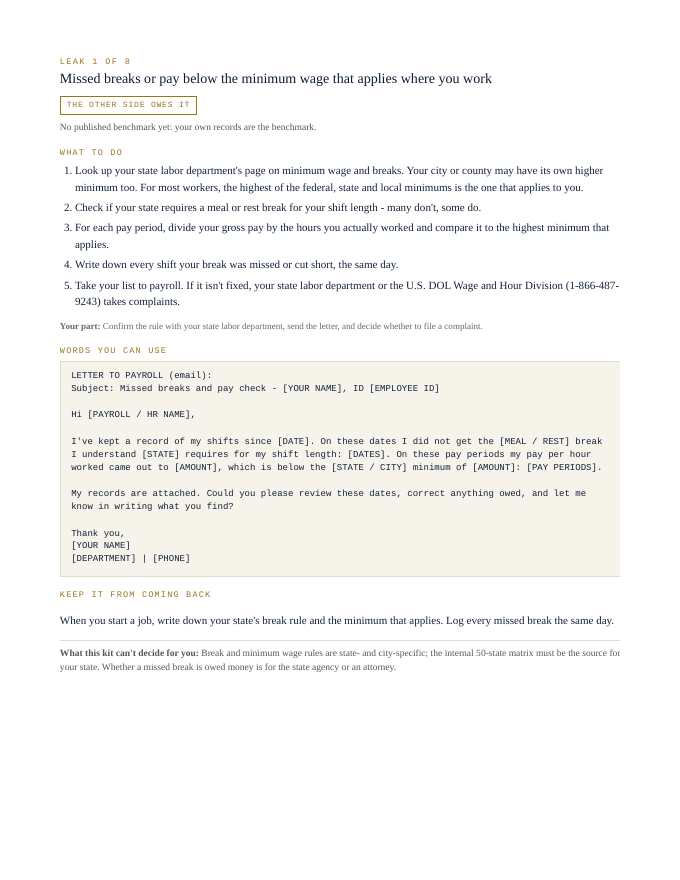
Missed breaks or pay below the minimum wage that applies where you work
The other side owes it- Look up your state labor department's page on minimum wage and breaks. Your city or county may have its own higher minimum too. For most workers, the highest of the federal, state and local minimums is the one that applies to you.
- Check if your state requires a meal or rest break for your shift length - many don't, some do.
- For each pay period, divide your gross pay by the hours you actually worked and compare it to the highest minimum that applies.
- Write down every shift your break was missed or cut short, the same day.
- Take your list to payroll. If it isn't fixed, your state labor department or the U.S. DOL Wage and Hour Division (1-866-487-9243) takes complaints.
Your part: Confirm the rule with your state labor department, send the letter, and decide whether to file a complaint.
LETTER TO PAYROLL (email):
Subject: Missed breaks and pay check - [YOUR NAME], ID [EMPLOYEE ID]

Hi [PAYROLL / HR NAME],

I've kept a record of my shifts since [DATE]. On these dates I did not get the [MEAL / REST] break I understand [STATE] requires for my shift length: [DATES]. On these pay periods my pay per hour worked came out to [AMOUNT], which is below the [STATE / CITY] minimum of [AMOUNT]: [PAY PERIODS].

My records are attached. Could you please review these dates, correct anything owed, and let me know in writing what you find?

Thank you,
[YOUR NAME]
[DEPARTMENT] | [PHONE]
When you start a job, write down your state's break rule and the minimum that applies. Log every missed break the same day.
What this kit can't decide for you: Break and minimum wage rules are state- and city-specific; the internal 50-state matrix must be the source for your state. Whether a missed break is owed money is for the state agency or an attorney.
That's 1 of 8. The other 7 come the same way in the kit: steps, words to send, a habit to keep each one closed.
Opens secure checkout. Instant download after payment. 30 days to ask for a refund — refund policy · terms
What people in this work look up
When hourly W-2 workers go looking for answers, they search things like “paycheck calculator”, “pay stub”, “overtime calculator” and “wage theft”. Those searches turn up forms, averages and other people's numbers. This kit starts from your own records instead: the 8 places money leaks in this work, where to look first and the words to send to close each one.
What you get for each leak
- Numbered steps to close each leak
- Your part, spelled out
- Words you can use: letters and scripts, ready to send (fill in the brackets)
- A habit that keeps each leak from coming back
- An honest line on what the kit can't decide for you
A page from the kit
Questions people ask
How do I know my overtime is figured right?
Overtime has to include bonuses and differentials, not just base pay. The kit shows how to check your stub.
Is time-clock rounding legal?
Rounding that only ever rounds against you is a leak the kit covers.
Who has to prove my hours?
Many workers think it's their job. The kit shows what records the employer keeps and what to keep yourself.
What it can't decide for you
This kit works from your own records. It doesn't give legal, tax, licensing or financial advice, and it never tells you what to charge. Where a CPA, attorney, insurer or state board makes the call, the kit says so and gets your records ready for them.
12-page PDF · instant download after payment · Code VYR-KIT-STUBBS-01
Opens secure checkout. Instant download after payment. 30 days to ask for a refund — refund policy · terms
Use Jobber or Housecall Pro? Run the free leak check — it reads your job export in your browser and shows the money leaks the software doesn't flag. Nothing is uploaded.