The Home Health & Personal Care Aides Fix Kit
Built for home health aides, personal care aides and private caregivers.
The aides doing best aren't necessarily working the most hours — they're the ones who know their real hourly once travel time is counted, and who know whether their pay classification matches the actual skill of the work they're doing. This kit finds where the money leaks in your own work and gives you the steps and the words to close each one.
Opens secure checkout. Instant download after payment. 30 days to ask for a refund — refund policy · terms
The 18 leaks it covers
9 you can close it · 9 the other side owes it
- Private-pay aide may be the family's household employee, not self-employedWhere to look first: List every family that pays you directly. For each, write down: who sets your hours, who tells you how the care is done, and whose home and supplies you use.Keep it from coming back: Before you start with any new family, ask in writing how they will report your pay and whether you will get a W-2.You can close it
- 80/20 rule doesn't bite until 2030 — no raise from it this yearWhere to look first: Nothing recovers this one right now - the federal 80% floor is not in force until 2030 and does not raise the state rate itself.Keep it from coming back: Re-check your state's published rate each July, when states update these pages, and compare it to your stub.You can close it
- Doesn't know which clients are Medicaid-funded vs private-pay — the ceiling only binds oneWhere to look first: Ask your agency which of your clients are Medicaid-funded and which pay privately.Keep it from coming back: When you take a new client, ask whether they are Medicaid or private pay and write it on your client list.You can close it
- Tenure never priced into a raise ask while caregivers churn around youWhere to look first: Write down your start date and how many caregivers you have seen come and go on your clients or your team since then.Keep it from coming back: Put a pay-review date on your calendar every year on your start-date anniversary, and keep a running list of extra shifts and client compliments as they happen so the ask is ready.You can close it
- Never looked up the state's published Medicaid hourly rate for your serviceWhere to look first: Go to your state Medicaid agency's website and search for 'fee schedule' or 'payment rate disclosure' or 'average hourly rate' for personal care, home health aide or homemaker services. States had to post these by July 1, 2026.Keep it from coming back: Check the page each July when states update it, and keep a screenshot with the date.You can close it
- Doesn't know if your rate is set by the agency or negotiable in a self-directed programWhere to look first: Look at your pay stub and any paperwork you signed. Who pays you: an agency, a 'fiscal intermediary' or 'financial management service' (a company that runs payroll for a self-directed program), or the family directly?Keep it from coming back: Before starting any new client, ask in writing who sets the rate, who runs payroll, and whether you will get a W-2.You can close it
- Doesn't know what the agency bills for your hour — prices private work too lowWhere to look first: Ask your agency, politely, what it bills the client or the program for your hour. They may not tell you; asking is still fine.Keep it from coming back: Keep one written rate sheet for private work and update it once a year; never quote a private family off your agency hourly wage.You can close it
- Health premium deduction asked about before anyone settles whether you are self-employedWhere to look first: First question, before insurance: for clients who pay you directly, are you self-employed or their household employee? (See the household-employee leak.) A CPA decides this.Keep it from coming back: Each January, start a 12-month sheet: premium paid, and whether any employer plan was open to you or your spouse that month.You can close it
- Never priced the same aide work in a facility or a state-government jobWhere to look first: Look up aide pay for your state and metro on the BLS wage tables (bls.gov/oes, occupation 31-1120). The page also lists pay by type of employer - look at facilities and state government.Keep it from coming back: Re-check the public wage tables for your area once a year, the week before your pay review.You can close it
- Hours for two clients through one intermediary never added together for overtimeWhere to look first: For each week, add up your hours for every client and program you work through the same agency, fiscal intermediary or company.Keep it from coming back: Keep one weekly total across all your clients, not one per client, and check it against your stubs each week.The other side owes it
- Agency tells you you're 'companionship exempt' and pays no overtimeWhere to look first: Pull your pay stubs for every week you worked over 40 hours and write down hours worked and overtime paid.Keep it from coming back: Keep your own weekly hours log, and check each stub for an overtime line in any week over 40.The other side owes it
- Sleep time deducted from overnight shifts shorter than 24 hours, or broken sleep unpaidWhere to look first: For each overnight, write down the shift start and end. If the shift was under 24 hours, sleep time generally cannot be taken off.Keep it from coming back: Start a night log on your first overnight with any client, and ask for a copy of any sleep-time agreement before you sign it.The other side owes it
- Failed EVV clock-ins you can't fix — hours quietly go unpaidWhere to look first: Keep your own record of every shift: client, date, time in, time out. A photo of a paper log or a note on your phone works.Keep it from coming back: Report every failed clock-in in writing the same day, and check each stub against your own log before the next pay period starts.The other side owes it
- Part-time paid hours, not the hourly rate, cap the yearWhere to look first: Pick last week. Write down the hours on your pay stub and the hours you were away from home for work (first leave to last return).Keep it from coming back: Track paid hours against hours away each week; ask for schedule changes as soon as a client ends, before the gap becomes your normal week.The other side owes it
- Paid on a 1099 by a registry or agency — label never questioned, no overtimeWhere to look first: Write down the facts: who sets your schedule, who sets your rate, who picks your clients, who trains and supervises you, whether you can turn work down, and whether you have other clients of your own.Keep it from coming back: Before taking any 1099 placement, ask in writing who sets the schedule, rate and client list - and get the answer saved.The other side owes it
- Drive time between clients left off the timesheet (and out of overtime)Where to look first: Starting today, write down the time you leave each client and the time you arrive at the next one. Your phone notes app is enough.Keep it from coming back: Log leave and arrive times every workday, and check each pay stub against the weekly total the day you get it.The other side owes it
- Doing home-health-aide-level tasks while classified and paid as a personal care aideWhere to look first: For two weeks, write down the tasks you do that are in the client's care plan - for example vital signs, medication reminders, wound or skin checks.Keep it from coming back: Before accepting a new client, read the care plan and ask whether the tasks on it match your job title and training.The other side owes it
- Client's authorized hours cut or capped — your paid hours drop with no explanationWhere to look first: When a client's hours are cut, ask your agency in writing what changed and when.Keep it from coming back: Keep at least two clients when you can, and ask about any client's next authorization renewal date so a cut doesn't surprise you.The other side owes it
Free: one full leak from this kit
No sign-up, no email. Here is leak 1 of 18 exactly as it appears in the kit, so you can see what you get before you buy.
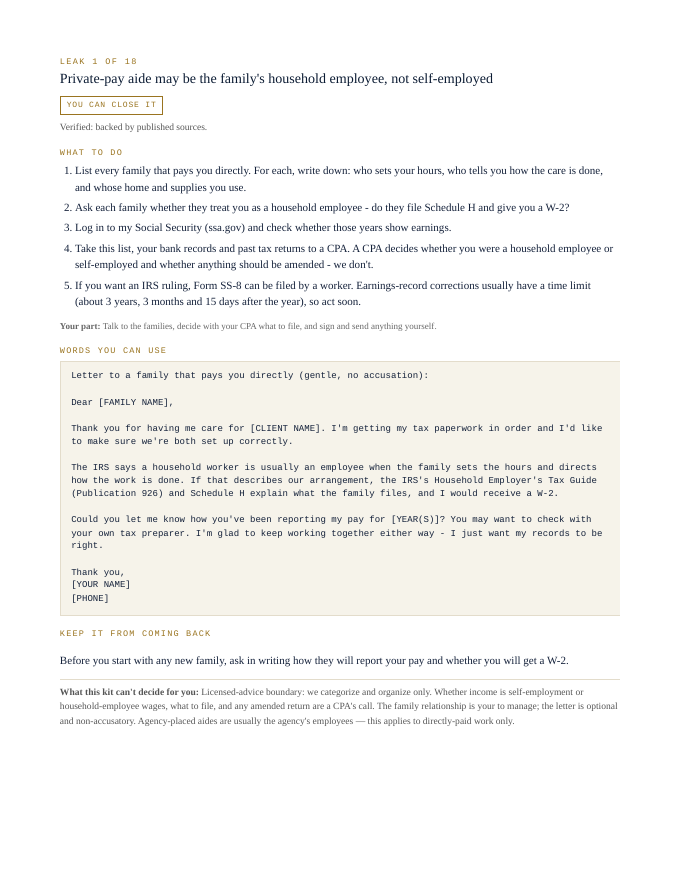
Private-pay aide may be the family's household employee, not self-employed
You can close it- List every family that pays you directly. For each, write down: who sets your hours, who tells you how the care is done, and whose home and supplies you use.
- Ask each family whether they treat you as a household employee - do they file Schedule H and give you a W-2?
- Log in to my Social Security (ssa.gov) and check whether those years show earnings.
- Take this list, your bank records and past tax returns to a CPA. A CPA decides whether you were a household employee or self-employed and whether anything should be amended - we don't.
- If you want an IRS ruling, Form SS-8 can be filed by a worker. Earnings-record corrections usually have a time limit (about 3 years, 3 months and 15 days after the year), so act soon.
Your part: Talk to the families, decide with your CPA what to file, and sign and send anything yourself.
Letter to a family that pays you directly (gentle, no accusation):

Dear [FAMILY NAME],

Thank you for having me care for [CLIENT NAME]. I'm getting my tax paperwork in order and I'd like to make sure we're both set up correctly.

The IRS says a household worker is usually an employee when the family sets the hours and directs how the work is done. If that describes our arrangement, the IRS's Household Employer's Tax Guide (Publication 926) and Schedule H explain what the family files, and I would receive a W-2.

Could you let me know how you've been reporting my pay for [YEAR(S)]? You may want to check with your own tax preparer. I'm glad to keep working together either way - I just want my records to be right.

Thank you,
[YOUR NAME]
[PHONE]
Before you start with any new family, ask in writing how they will report your pay and whether you will get a W-2.
What this kit can't decide for you: Licensed-advice boundary: we categorize and organize only. Whether income is self-employment or household-employee wages, what to file, and any amended return are a CPA's call. The family relationship is your to manage; the letter is optional and non-accusatory. Agency-placed aides are usually the agency's employees — this applies to directly-paid work only.
That's 1 of 18. The other 17 come the same way in the kit: steps, words to send, a habit to keep each one closed.
Opens secure checkout. Instant download after payment. 30 days to ask for a refund — refund policy · terms
What people in this work look up
When home health and personal care aides go looking for answers, they search things like “household employee taxes”, “home health aide salary”, “home health aide pay” and “companionship exemption”. Those searches turn up forms, averages and other people's numbers. This kit starts from your own records instead: the 18 places money leaks in this work, where to look first and the words to send to close each one.
What you get for each leak
- Numbered steps to close each leak
- Your part, spelled out
- Words you can use: letters and scripts, ready to send (fill in the brackets)
- A habit that keeps each leak from coming back
- An honest line on what the kit can't decide for you
A page from the kit
Questions people ask
Do home health aides get overtime?
Usually yes. Being told you're 'companionship exempt', or having hours for two clients through one agency kept apart, are leaks the kit covers.
Should drive time between clients be paid?
Drive time between clients is often left off the timesheet and out of overtime. The kit shows how to check yours.
Am I a household employee or self-employed?
A private-pay aide may be the family's household employee. The kit shows what to sort out first.
What it can't decide for you
This kit works from your own records. It doesn't give legal, tax, licensing or financial advice, and it never tells you what to charge. Where a CPA, attorney, insurer or state board makes the call, the kit says so and gets your records ready for them.
23-page PDF · instant download after payment · Code VYR-KIT-HAZEL-01
Opens secure checkout. Instant download after payment. 30 days to ask for a refund — refund policy · terms
Use Jobber or Housecall Pro? Run the free leak check — it reads your job export in your browser and shows the money leaks the software doesn't flag. Nothing is uploaded.