The Low-Voltage, Security & Fire Alarm Fix Kit
Built for low-voltage, security system, access control and fire alarm contractors.
This trade runs on two separate ledgers that almost never get checked against each other. This kit finds where the money leaks in your own work and gives you the steps and the words to close each one.
Opens secure checkout. Instant download after payment. 30 days to ask for a refund — refund policy · terms
The 6 leaks it covers
3 you can close it · 2 the other side owes it · 1 a pro decides
- Alarm registration, contractor class or NICET level missing or lapsed for the stateWhere to look first: List every state you install, service or monitor in.Keep it from coming back: Before bidding work in a new state, check its license and certification rule first.You can close it
- Final invoice built from the bid, not the as-built record; field-added devices unbilledWhere to look first: Before you send the final invoice, pull the as-built drawings and record of completion the fire alarm code (NFPA 72) already requires you to produce.Keep it from coming back: Make the as-built-versus-bid check a required step before any final invoice goes out, and get extras approved in writing before they go in.You can close it
- Assuming one city's alarm-permit and false-alarm rules apply everywhereWhere to look first: List every city and county you install in. For each, look up its alarm ordinance — permits, registration, false-alarm fines and who pays them.Keep it from coming back: Before the first install in a new city, check its alarm ordinance and add it to your sheet.You can close it
- Monitoring accounts live at the central station but missing from customer billingWhere to look first: Ask your central station for a full export of your active accounts.Keep it from coming back: Add a monitoring account to billing the same day it is activated at the central station, and reconcile the two lists monthly.The other side owes it
- Business value distorted by an unreconciled monitoring-account count (RMR)Where to look first: Nothing to recover here — this is about knowing what your business is really worth. Once a quarter, pull your central station's active-account list and your billing system's active monitoring invoices.Keep it from coming back: Reconcile quarterly and keep the dated list, so your account count is never a guess.The other side owes it
- Self-employment tax not budgeted through the year (alarm and low-voltage)Where to look first: Nothing is owed back to you here — this is about not getting caught short in April. Pull last year's return or your year-to-date records and find your NET business income (what came in minus your business costs), not your gross.Keep it from coming back: Move your tax share into a separate account the day each payment lands, and set calendar reminders two weeks before each estimated-tax date.A pro decides
Free: one full leak from this kit
No sign-up, no email. Here is leak 1 of 6 exactly as it appears in the kit, so you can see what you get before you buy.
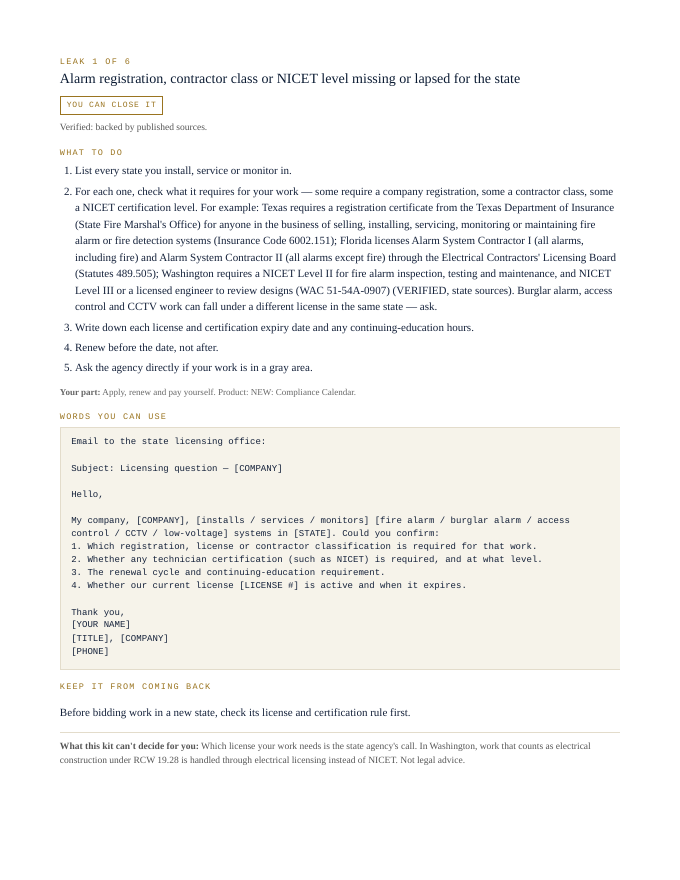
Alarm registration, contractor class or NICET level missing or lapsed for the state
You can close it- List every state you install, service or monitor in.
- For each one, check what it requires for your work — some require a company registration, some a contractor class, some a NICET certification level. For example: Texas requires a registration certificate from the Texas Department of Insurance (State Fire Marshal's Office) for anyone in the business of selling, installing, servicing, monitoring or maintaining fire alarm or fire detection systems (Insurance Code 6002.151); Florida licenses Alarm System Contractor I (all alarms, including fire) and Alarm System Contractor II (all alarms except fire) through the Electrical Contractors' Licensing Board (Statutes 489.505); Washington requires a NICET Level II for fire alarm inspection, testing and maintenance, and NICET Level III or a licensed engineer to review designs (WAC 51-54A-0907) (VERIFIED, state sources). Burglar alarm, access control and CCTV work can fall under a different license in the same state — ask.
- Write down each license and certification expiry date and any continuing-education hours.
- Renew before the date, not after.
- Ask the agency directly if your work is in a gray area.
Your part: Apply, renew and pay yourself. Product: NEW: Compliance Calendar.
Email to the state licensing office:

Subject: Licensing question — [COMPANY]

Hello,

My company, [COMPANY], [installs / services / monitors] [fire alarm / burglar alarm / access control / CCTV / low-voltage] systems in [STATE]. Could you confirm:
1. Which registration, license or contractor classification is required for that work.
2. Whether any technician certification (such as NICET) is required, and at what level.
3. The renewal cycle and continuing-education requirement.
4. Whether our current license [LICENSE #] is active and when it expires.

Thank you,
[YOUR NAME]
[TITLE], [COMPANY]
[PHONE]
Before bidding work in a new state, check its license and certification rule first.
What this kit can't decide for you: Which license your work needs is the state agency's call. In Washington, work that counts as electrical construction under RCW 19.28 is handled through electrical licensing instead of NICET. Not legal advice.
That's 1 of 6. The other 5 come the same way in the kit: steps, words to send, a habit to keep each one closed.
Opens secure checkout. Instant download after payment. 30 days to ask for a refund — refund policy · terms
What people in this work look up
When low-voltage, security and fire alarm contractors go looking for answers, they search things like “nicet certification”, “low voltage contractor”, “low voltage license” and “alarm monitoring rates”. Those searches turn up forms, averages and other people's numbers. This kit starts from your own records instead: the 6 places money leaks in this work, where to look first and the words to send to close each one.
What you get for each leak
- Numbered steps to close each leak
- Your part, spelled out
- Words you can use: letters and scripts, ready to send (fill in the brackets)
- A habit that keeps each leak from coming back
- An honest line on what the kit can't decide for you
A page from the kit
Questions people ask
Why doesn't my final invoice match the job?
Final invoices built from the bid instead of the as-built record leave field-added devices unbilled. The kit shows the fix.
Are monitoring accounts being billed?
Accounts live at the central station can be missing from customer billing. The kit shows how to reconcile.
Is my NICET level and registration current?
Lapsed registration, contractor class or NICET level is the first leak in the kit.
What it can't decide for you
This kit works from your own records. It doesn't give legal, tax, licensing or financial advice, and it never tells you what to charge. Where a CPA, attorney, insurer or state board makes the call, the kit says so and gets your records ready for them.
10-page PDF · instant download after payment · Code VYR-KIT-SENTRY-01
Opens secure checkout. Instant download after payment. 30 days to ask for a refund — refund policy · terms
Use Jobber or Housecall Pro? Run the free leak check — it reads your job export in your browser and shows the money leaks the software doesn't flag. Nothing is uploaded.