The Diesel & Mobile Mechanics Fix Kit
Built for diesel mechanics and technicians, truck mechanics and mobile mechanics.
Two technicians doing the identical repair under the identical flat-rate system can take home very different real hourly pay — the difference is how fast they work against the book, not how skilled they are. This kit finds where the money leaks in your own work and gives you the steps and the words to close each one.
Opens secure checkout. Instant download after payment. 30 days to ask for a refund — refund policy · terms
The 10 leaks it covers
3 you can close it · 5 the other side owes it · 2 a pro decides
- Specialty work (diesel, European, EV) billed at the same rate as general workWhere to look first: Pull your last 3 months of invoices (if you're independent) or repair orders (if you're at a shop).Keep it from coming back: Tag each job as specialty or general when you write the invoice. Price specialty work separately from day one with every new customer.You can close it
- Going mobile: income premium vs. lost stability and benefits never weighedWhere to look first: This one is a choice, not money lost. Weigh it with your own numbers: Ask HR for a total-compensation or benefits summary - what your employer pays for health insurance, retirement match, paid time off, tools allowance, uniforms (letter…Keep it from coming back: Before giving notice, have the side-by-side done with your own numbers and at least a few fleet conversations behind it.You can close it
- Never priced your own hour at mobile-repair rates vs. your wageWhere to look first: Nothing is owed to you here. This is about knowing your own number. Write down your current hourly wage (from your pay stub).Keep it from coming back: Before quoting your first mobile job, have a written floor rate built from your own costs. Re-check it every time a big cost (insurance, truck payment) changes.You can close it
- Doesn't know what the shop bills per labor hour vs. what you're paidWhere to look first: Ask the service writer or look at a customer repair order: what is the shop's labor rate per hour? Write it down.Keep it from coming back: Write down the shop's labor rate each time it changes, and your own rate, so the comparison is ready at review time.The other side owes it
- Flat-rate book time: real hourly rate depends on speed vs. the bookWhere to look first: Pull your pay stubs for the last 8 weeks. For each week, divide flag hours paid by hours clocked in. Over 1.0 means you beat the book; under 1.0 means the book beat you.Keep it from coming back: Log clocked time on each repair order the day you do it. Check your flag-to-clock ratio every payday.The other side owes it
- Slow flat-rate week pays below minimum wage and the make-up pay never showsWhere to look first: For any slow week (parts backorder, bad diagnostic), take your total pay for the week and divide by every hour you were clocked in.Keep it from coming back: Every payday, divide gross by clocked hours. If a slow week is coming (parts backorder), write down your clock-in and clock-out times that week.The other side owes it
- Flat-rate pay: clock hours with no flag hours (diagnostics, parts waits) left unpaidWhere to look first: Pull your last 8 weeks of pay stubs and your own clock-in/clock-out record (shop time clock printout, or your phone notes).Keep it from coming back: Keep your own daily clock-in/clock-out note and flag hours per repair order, starting today. Before taking a flat-rate job, ask in writing how non-repair time (diagnostics, parts waits, shop work) is paid.The other side owes it
- Diesel tech pay never checked against the federal medianWhere to look first: Take your yearly pay (last year's W-2, or this year's stubs times the weeks). If you're paid flat rate, use what you actually made, not your flag rate.Keep it from coming back: Recheck your real pay against the current BLS figure once a year, before your review date.The other side owes it
- Independent mechanic: nothing set aside for taxes before it's spentWhere to look first: Nothing withholds tax from your customer payments, so the set-aside has to be your habit. Open a separate savings account just for taxes.Keep it from coming back: Move the tax share the same day each payment lands. Set the quarterly reminders now for the rest of the year.A pro decides
- Tax set-aside figured on invoice totals, including parts that pass throughWhere to look first: Self-employment tax falls on your profit, not on what customers pay you. In this trade, parts run through the invoice but aren't profit. Pull last quarter's invoices.Keep it from coming back: Show parts and labor as separate lines on every invoice. Snap each receipt the day you buy.A pro decides
Free: one full leak from this kit
No sign-up, no email. Here is leak 1 of 10 exactly as it appears in the kit, so you can see what you get before you buy.
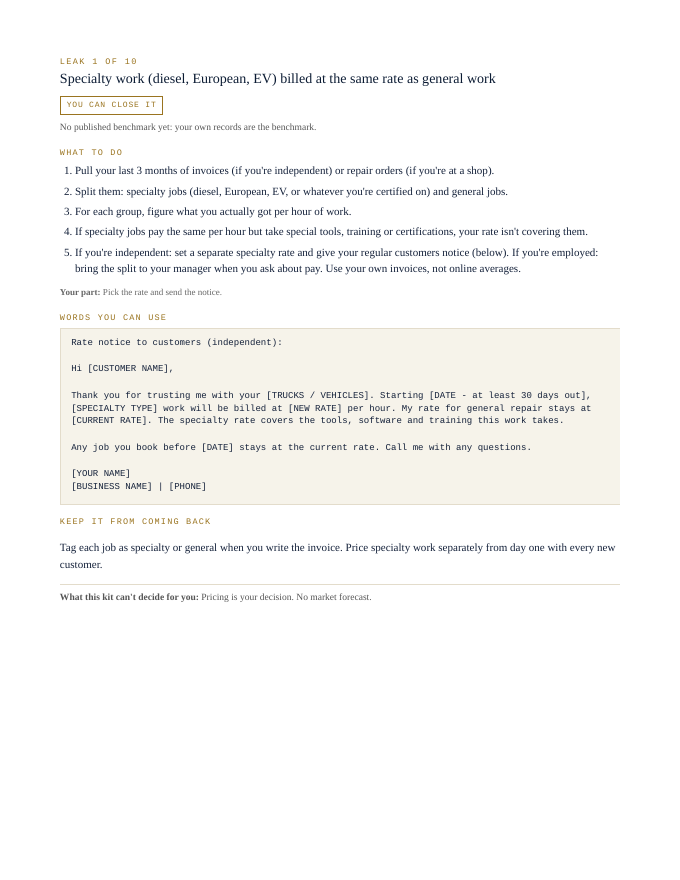
Specialty work (diesel, European, EV) billed at the same rate as general work
You can close it- Pull your last 3 months of invoices (if you're independent) or repair orders (if you're at a shop).
- Split them: specialty jobs (diesel, European, EV, or whatever you're certified on) and general jobs.
- For each group, figure what you actually got per hour of work.
- If specialty jobs pay the same per hour but take special tools, training or certifications, your rate isn't covering them.
- If you're independent: set a separate specialty rate and give your regular customers notice (below). If you're employed: bring the split to your manager when you ask about pay. Use your own invoices, not online averages.
Your part: Pick the rate and send the notice.
Rate notice to customers (independent):

Hi [CUSTOMER NAME],

Thank you for trusting me with your [TRUCKS / VEHICLES]. Starting [DATE - at least 30 days out], [SPECIALTY TYPE] work will be billed at [NEW RATE] per hour. My rate for general repair stays at [CURRENT RATE]. The specialty rate covers the tools, software and training this work takes.

Any job you book before [DATE] stays at the current rate. Call me with any questions.

[YOUR NAME]
[BUSINESS NAME] | [PHONE]
Tag each job as specialty or general when you write the invoice. Price specialty work separately from day one with every new customer.
What this kit can't decide for you: Pricing is your decision. No market forecast.
That's 1 of 10. The other 9 come the same way in the kit: steps, words to send, a habit to keep each one closed.
Opens secure checkout. Instant download after payment. 30 days to ask for a refund — refund policy · terms
What people in this work look up
When diesel and mobile mechanics go looking for answers, they search things like “mobile mechanic rates”, “diesel mechanic pay”, “diesel mechanic salary”, “diesel technician pay” and “mobile mechanic business”. Those searches turn up forms, averages and other people's numbers. This kit starts from your own records instead: the 10 places money leaks in this work, where to look first and the words to send to close each one.
What you get for each leak
- Numbered steps to close each leak
- Your part, spelled out
- Words you can use: letters and scripts, ready to send (fill in the brackets)
- A habit that keeps each leak from coming back
- An honest line on what the kit can't decide for you
A page from the kit
Questions people ask
How does flat-rate mechanic pay work against my real hours?
Your real hourly depends on your speed against the book, and diagnostics and parts waits can go unpaid. The kit shows how to check it.
What should a mobile mechanic charge?
Price your own hour at mobile-repair rates, not your shop wage. The kit walks you through it.
Should diesel work pay more than general work?
Yes. Specialty work billed at the general rate is one of the leaks the kit covers.
What it can't decide for you
This kit works from your own records. It doesn't give legal, tax, licensing or financial advice, and it never tells you what to charge. Where a CPA, attorney, insurer or state board makes the call, the kit says so and gets your records ready for them.
15-page PDF · instant download after payment · Code VYR-KIT-TORQUE-01
Opens secure checkout. Instant download after payment. 30 days to ask for a refund — refund policy · terms
Use Jobber or Housecall Pro? Run the free leak check — it reads your job export in your browser and shows the money leaks the software doesn't flag. Nothing is uploaded.